
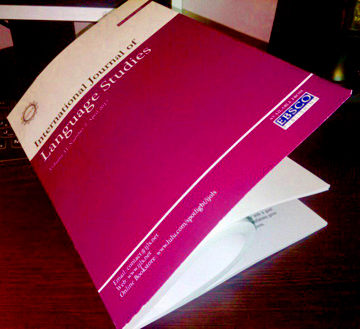
International Journal of Language Studies
A Quarterly Journal of Applied Linguistics
ISSN: 2157-4898 | eISSN: 2157-4901
Sherpa/RoMEO Color: Yellow
Editor: Mohammad A. Salmani Nodoushan
April 2026 - Volume 20 Number 2 - Pages 1-107
Asterisk (*) indicates corresponding author.
BACK TO TOP
Preferred English language learning strategies among undergraduate EFL students: A Voice from Indonesia
, Universitas Iskandar Muda, Aceh, Indonesia | Contact Author *
, Institute Seni Budaya Aceh, Aceh, Indonesia | Contact Author
, Universitas Iskandar Muda, Aceh, Indonesia | Contact Author
, Universitas Iskandar Muda, Aceh, Indonesia | Contact Author
International Journal of Language Studies, 20(2), 1-20. | Download PDF | Add Print to Cart
The high demand for English proficiency in the globalization era has led EFL learners to adopt various strategies to enhance their language skills. This research aims to investigate the kinds of English language learning strategies employed by Indonesian EFL university students. A descriptive quantitative method employing a five-point Likert scale was used to collect data from 70 English Department students purposively selected from several universities in Indonesia. Results of the research revealed that metacognitive strategies become the most frequently used strategies in English language learning. The strategies help the learners organize their learning through planning, centering, monitoring and evaluating how well they have done in the learning process. It means that the learners possess self-awareness to regulate their own learning and can manage their intrinsic motivation for learning. The result of the study has a significant implication for teachers in that they can adjust the learning materials based on the preferred strategies, and the students can also expand their learning strategies according to the strategies they already used.
Citation: Muliawati, I., Lismalinda, L., Yusnida, D., & Ayouni, N. (2026). Preferred English language learning strategies among undergraduate EFL students: A Voice from Indonesia. International Journal of Language Studies, 20(2), 1-20. https://doi.org/10.5281/zenodo.20577078
Keywords: Direct Learning Strategies; Foreign Language Learning Strategies; Indirect Learning Strategies; Language Learning Strategies; SILL Questionnaire
BACK TO TOP
The cognitive processing of EFL readers completing banked gap-fill tasks: Evidence from eye-tracking
, UT International Kish Campus, Iran | Contact Author
, University of Tehran, Iran | Contact Authorr *
International Journal of Language Studies, 20(2), 21-40. | Download PDF | Add Print to Cart
The present study aimed to explore whether different levels of reading proficiency and task difficulty influence specific eye-movement metrics and how these relate to higher- and lower-level reading processes. A mixed-methods design was employed with twenty university students who completed two banked gap-fill tasks across B1 and C1 levels. Quantitative data from eye-tracking measures were complemented by stimulated recall interviews to gain deeper insights into participants' cognitive strategies, including inference and background knowledge utilization. The findings showed that, at lower level (B1), there are no significant differences in eye-movement patterns between high- and low-performing readers, suggesting the tasks mainly assess local, lower-level decoding skills. At the advanced C1 level, slight differences emerge, with higher performers demonstrating more efficient processing and greater reliance on higher-level reading cognitive processes. Regression analysis revealed that lower performers tend to switch their gaze more frequently between the text and word bank, indicating reliance on lower-level processes. The qualitative data supported these findings, showing that higher performers engaged more frequently in inference and background knowledge, particularly at the C1 level. The study highlights the utility of eye-tracking as a valid tool to examine real-time cognitive processing and its implications for test design and language teaching. Recommendations include employing higher-level reading tasks for assessing global reading skills and integrating eye-movement analysis into test validation processes.
Citation: Mirzabagheri, H. R., & Karami, H. (2026). The cognitive processing of EFL readers completing banked gap-fill tasks: Evidence from eye-tracking. International Journal of Language Studies, 20(2), 21-40. https://doi.org/10.5281/zenodo.20577158
Keywords: Eye-tracking; Banked gap-filling Readings; Reading Cognitive Processes
BACK TO TOP
Assessing at a distance: Formative assessment in Indonesian EFL higher education
, Universitas Syiah Kuala, Indonesia | Contact Author *
, Philippine Normal University, Philippines | Contact Author
International Journal of Language Studies, 20(2), 41-64. | Download PDF | Add Print to Cart
This study is intended to examine the practices of Remote Formative Assessment (RFA) employed by English language lecturers during online teaching sessions. This study used a qualitative case study approach involving 15 lecturers from three state universities located in Aceh Province, Indonesia: Universitas Syiah Kuala, Universitas Islam Negeri Ar-Raniry, and Universitas Samudera. Data were gathered using semi-structured interviews and digital artifact analysis, and the information was examined through thematic analysis. The study identified five prominent practices in the implementation of RFA: (1) adapting assessment activities to digital platforms, (2) providing timely and constructive feedback, (3) monitoring students’ learning progress, (4) facilitating collaborative learning, and (5) utilizing multimodal assessment tools. These practices illustrate how lecturers combine numerous digital platforms to maintain formative assessment principles in remote learning. The study highlights the pedagogical implications of RFA for supporting continuous feedback, learner engagement, and adaptive assessment in English language learning in Indonesian higher education.
Citation: Yuliana, Y., & Amarles, A. M. (2026). Assessing at a distance: Formative assessment in Indonesian EFL higher education. International Journal of Language Studies, 20(2), 41-64. https://doi.org/10.5281/zenodo.20577230
Keywords: Digital Assessment Tools; English Language Teaching; Higher Education; Online Learning; Remote Formative Assessment
BACK TO TOP
The effects of peer-translanguaging on academic writing essays in Vietnamese universities
, Hue University of Foreign Languages and International Studies, Hue University, Vietnam | Contact Author *
, University of Education, Vietnam National University Hanoi Vietnam | Contact Author
, FPT University, Vietnam | Contact Author
, Felis Study English Center, Vietnam | Contact Author
International Journal of Language Studies, 20(2), 65-86. | Download PDF | Add Print to Cart
This paper examines how peer translanguaging, or the flexible application of both Vietnamese (L1) and English (L2) in academic writing by students, influences academic writing performance of Vietnamese EFL university students. The study uses the Sociocultural Theory (SCT) and the Zone of Proximal Development (ZPD) to analyze the role of peer translanguaging in the writing development of learners in three phases: pre-writing, during writing, and after writing. Quantitative design was applied, and a 46-item questionnaire was administered to 200 participants (N =200). The findings revealed that peer translanguaging is a strong tool in boosting idea generation, textual coherence, learner engagement, and revision quality. It also encourages inclusive learning, alleviates language anxiety, and encourages collaborative learning. Regardless of its advantages, there were certain difficulties, such as the confusion due to the dialectal variation and the inability to balance between the L1 and L2 use. The results, in general, confirm that peer translanguaging is a useful scaffolding process that promotes both linguistic and emotional growth. It is a very important pedagogical tool as a transformative approach to multilingual EFL academic writing situations.
Citation: Nguyen, V. H., Dang, M. T., Nguyen, N. H., & Vuong, D. H. (2026). The effects of peer-translanguaging on academic writing essays in Vietnamese universities. International Journal of Language Studies, 20(2), 65-86. https://doi.org/10.5281/zenodo.20577294
Keywords: Academic Writing; EFL; Sociocultural Theory; Translanguaging; Zone of Proximal Development
BACK TO TOP
Students’ challenges and needs in essay writing: A qualitative study at Universitas Syiah Kuala
, Universitas Syiah Kuala, Indonesia | Contact Author *
, Mae Fah Luang University, Thailand | Contact Author
, Universitas Syiah Kuala, Indonesia | Contact Author
International Journal of Language Studies, 20(2), 87-107. | Download PDF | Add Print to Cart
Essay writing is a fundamental component of academic literacy in English Education programs. Many EFL students continue to face difficulties despite completing essay writing courses. This qualitative descriptive study aims to identify students’ linguistic difficulties in essay writing and explore their learning needs after completing the course. The study was conducted at the Department of English Education, Universitas Syiah Kuala, Indonesia. Data were collected through a closed-ended questionnaire administered to 93 fifth-semester students and semi-structured interviews with 10 selected participants. The findings reveal that grammar is perceived as the most severe difficulty (M = 4.17), while word choice is the most frequently reported issue (61.83%) with lower intensity (M = 3.75). Other aspects, including organization, supporting ideas, and spelling, are moderate difficulties whereas punctuation and capitalization are less problematic. The findings reveal the need for clearer instruction, ongoing feedback, and sustained support in essay-writing classes.
Citation: Fajrina, D., Wardana, A., & Askari, T. A. J. (2026). Students’ challenges and needs in essay writing: A qualitative study at Universitas Syiah Kuala. International Journal of Language Studies, 20(2), 87-107. https://doi.org/10.5281/zenodo.20577365
Keywords: EFL Students; Essay Writing; Learning Needs; Linguistics Difficulties
BACK TO TOP
Copyright © International Journal of Language Studies 2007 - All Rights Reserved
Template by OS Templates