
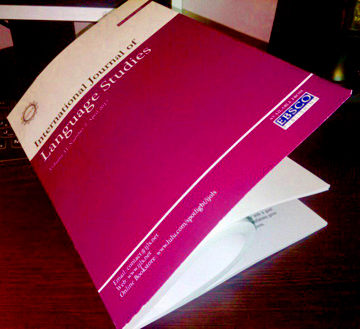
International Journal of Language Studies
A Quarterly Journal of Applied Linguistics
ISSN: 2157-4898 | eISSN: 2157-4901
Sherpa/RoMEO Color: Yellow
Editor: Mohammad A. Salmani Nodoushan
July 2026 - Volume 20 Number 3 - Pages 1-150
Asterisk (*) indicates corresponding author.
BACK TO TOP
The role of multiliteracies in language teaching in Greek secondary education
, University of Western Macedonia, Greece | Contact Author *
, University of Western Macedonia, Greece | Contact Author
, University of Western Macedonia, Greece | Contact Author
International Journal of Language Studies, 20(3), 1-18. | Download PDF | Add Print to Cart
This article demonstrates the results of a relevant primary research study about multiliteracies. Specifically, the purpose of the research was to investigate teachers’ opinions regarding the role and position of multiliteracies in language teaching context in Greece secondary education. Semi-structured interviews were utilized for data collection, followed by thematic qualitative analysis of the transcribed research material, which was obtained from these interviews. The analysis of the results indicates that the participants have a comprehensive grasp of multiliteracies in both theory and practice. They can accurately articulate the characteristics of multiliteracies, as well as their position and role in both society and education. It appears that teachers intentionally and deliberately opt to incorporate them into language teaching, citing students’ positive reaction and the consequential learning advantages. However, they express a lack of confidence and emphasize the necessity of additional training.
Citation: Moutsiouna, C., Griva, E., & Dinas, K. (2026). The role of multiliteracies in language teaching in Greek secondary education. International Journal of Language Studies, 20(3), 1-18. https://doi.org/10.5281/zenodo.20674688
Keywords: Greece; Language Teaching; Multiliteracies; Secondary Education; Teachers’ Views
BACK TO TOP
Sequencing feedback at scale: A cluster-randomized trial comparing AI-powered AWE and teacher feedback in Indonesian EFL academic writing
, Universitas Islam Negeri Ar-Raniry, Banda Aceh, Indonesia | Contact Author *
, Universitas Sultan Ageng Tirtayasa, Banten, Indonesia | Contact Author
International Journal of Language Studies, 20(3), 19-42. | Download PDF | Add Print to Cart
Large Indonesian EFL writing classes often struggle to provide timely, detailed teacher feedback. Automated Writing Evaluation (AWE) offers rapid responses, but its role in academic writing remains unclear. This mixed-method study compared AWE-led feedback with teacher feedback in a 10-week Indonesian undergraduate writing course and proposed a Hybrid AWE–Teacher Feedback Model. A PRISMA-guided review informed feedback design. The empirical phase used a cluster-randomized trial (N = 88; four classes): two received AWE feedback (Grammarly), and two received teacher feedback. Writing quality was measured by pre/post essays, and engagement was measured by revision logs, questionnaires, and interviews. Both groups improved. AWE produced greater gains in language use, vocabulary, and revision frequency, and higher post-test scores. Teacher feedback contributed more to idea development and rhetorical clarity. The results point to a staged strategy: use AWE for early, frequent revision, and reserve teacher feedback for higher-order concerns in writing.
Citation: Muluk, S., & Hasani, A. (2026). Sequencing feedback at scale: A cluster-randomized trial comparing AI-powered AWE and teacher feedback in Indonesian EFL academic writing. International Journal of Language Studies, 20(3), 19-42. https://doi.org/10.5281/zenodo.20674744
Keywords: Academic Writing; Automated Writing Evaluation; Feedback Literacy; Hybrid Feedback; Teacher Feedback
BACK TO TOP
A discourse-analytical study of the japa phenomenon in Nigerian digital and media narratives
, Bingham University, Nigeria | Contact Author *
, Bingham University, Nigeria | Contact Author
International Journal of Language Studies, 20(3), 43-62. | Download PDF | Add Print to Cart
This study analyses discussions on the Nigerian migration trend ‘japa’ to understand how it influences interpretations of citizenship and national identity. The research uses qualitative content analysis to explore 32 comments selected from four tweets by Punch Newspapers and The Vanguard on X (formerly Twitter) between 2022 and 2025, with eight comments per tweet. The study applies Norman Fairclough’s Three-Dimensional Model of Discourse and Theo van Leeuwen’s Social Actor Representation Theory to unpack linguistic, discursive, and social practices in the discourse. Findings reveal that users frame japa as a rational escape from a failing state and a contested moral act with implications for civic duty and legitimacy. Political elites are activated as agents of dysfunction, while youths are passivated as victims or reimagined as active dissenters through decision to emigrate. The study shows that japa functions as a metaphor where Nigerians critique state, negotiate identity, and reimagine citizenship beyond traditional boundaries.
Citation: Aluya, I., & Nwaegbe, N. U. (2026). A discourse-analytical study of the japa phenomenon in Nigerian digital and media narratives. International Journal of Language Studies, 20(3), 43-62. https://doi.org/10.5281/zenodo.20674772
Keywords: Civic Engagement; Critical Discourse; Digital Discourse; Migration; National Identity
BACK TO TOP
L1–L2 vowel relations in English monophthong production by Hijazi Arabic learners: Evidence from interactive phonetic training
, Taibah University, Saudi Arabia | Contact Author *
International Journal of Language Studies, 20(3), 63-84. | Download PDF | Add Print to Cart
Second-language (L2) vowel production depends on how learners relate non-native vowel categories to their first-language (L1) phonetic system, yet little is known about how vowel-specific difficulty and improvement can be explained within an L2 speech learning model. This study examined English monophthong production by Hijazi Arabic-speaking learners through Flege’s Speech Learning Model and compared mobile-based Interactive Phonetic Training (IPT) with Print-Based Phonetic Instruction (PBI). Forty Hijazi Arabic-speaking English majors completed pre-test and post-test production tasks involving eleven English monophthongs. Productions were analysed through vowel-specific confusion matrices and modelled using mixed-effects logistic regression. The results showed that learners had the greatest difficulty with vowels lacking direct Hijazi Arabic equivalents. The IPT group showed significantly greater post-test improvement than the PBI group, particularly for these difficult vowels. The findings suggest that interactive phonetic training can reduce L1-based substitutions and support more accurate L2 vowel production.
Citation: Almurashi, W. (2026). L1–L2 vowel relations in English monophthong production by Hijazi Arabic learners: Evidence from interactive phonetic training. International Journal of Language Studies, 20(3), 63-84. https://doi.org/10.5281/zenodo.20674822
Keywords: English Monophthong Production; Hijazi Arabic; Interactive Phonetic Training; L2 Phonetics; Speech Learning Model
BACK TO TOP
Academic translation evaluation revisited: A paradigm shift toward performance-oriented assessment
, Department of English, Isfahan Campus, Islamic Azad University, Isfahan, Iran | Contact Author *
, Department of English, Isfahan Campus, Islamic Azad University, Isfahan, Iran | Contact Author
International Journal of Language Studies, 20(3), 85-110. | Download PDF | Add Print to Cart
Assessing students’ academic translations is a common practice within translator education. Typically, this assessment is done by giving numerical scores to verify alignment between intended instructional purposes and actual learner achievements. As research shows, the practices most frequently adopted by instructors for evaluating translations in undergraduate English programs are largely rooted in the theoretical assumptions of Classical True Score Theory. This paper addresses the challenging issues inherent in such evaluative practices. To achieve this aim, the paper first offers a critical synopsis of the general landscape of language assessment, with a specific focus on translation evaluation, identifying the principal challenges and inherent constraints commonly associated with conventional translation tests. Performance-based evaluation is, then, proposed as a workable solution to the shortcomings of traditional testing. As both domains share considerable common ground in their nature, features, and objectives, the paper concludes that performance-based assessment aligns particularly well with academic translation evaluation.
Citation: Heidari Tabrizi, H., & Chalak, A. (2026). Academic translation evaluation revisited: A paradigm shift toward performance-oriented assessment. International Journal of Language Studies, 20(3), 85-110. https://doi.org/10.5281/zenodo.20807787
Keywords: Evaluating Academic Translations; Performance-Oriented Assessment; Translation Evaluation; Traditional Testing in Translator Education
BACK TO TOP
Speaking the ‘right’ English: Attitudes and beliefs of Italian students towards ‘native sounding’ and foreign-accented English
, University of Naples Federico II, Italy | Contact Author *
International Journal of Language Studies, 20(3), 111-134. | Download PDF | Add Print to Cart
This study examines the language attitudes and beliefs of Italians towards ‘native’ and ‘non-native’ varieties of spoken English, with particular attention to the evaluation of their Italian accent. Semi-structured interviews were carried out while the participants (19 students in higher education) were studying abroad. These revealed a deep-seated belief that a ‘native-sounding’ accent is required in order to become truly proficient in the language and to be taken seriously, which caused a strong sense of anxiety and inadequacy in the respondents. The interviews touched upon multiple topics, including their interactions with others while abroad, their fear of being discriminated against, and their struggles with identity and self-positioning. However, the longitudinal nature of this study revealed that the time spent abroad ultimately contributed to changing their attitudes, making them more open towards their multilingualism and their own Italian-sounding accent, although they remained aware of the possible advantages that ‘sounding native’ provides.
Citation: Cigliano, C. (2026). Speaking the ‘right’ English: Attitudes and beliefs of Italian students towards ‘native sounding’ and foreign-accented English. International Journal of Language Studies, 20(3), 111-134. https://doi.org/10.5281/zenodo.21054926
Keywords: Foreign Accent; English as a Lingua Franca; ELF; English Language Teaching; Linguistic Insecurity; Language Attitudes; Native-Speakerism
BACK TO TOP
Learning English grammar at university: A corpus-based error analysis of Italian B1+ EFL learners
, Università di Napoli Federico II, Italy | Contact Author *
, Università di Napoli Federico II, Italy | Contact Author
International Journal of Language Studies, 20(3), 135-150. | Download PDF | Add Print to Cart
The acquisition of grammatical competence remains a central concern in EFL contexts, particularly in academic settings where written accuracy constitutes an important marker of language proficiency. Error Analysis provides a valuable theoretical and methodological framework for investigating learner language, as it enables researchers to identify systematic patterns of deviation and explore the cognitive and linguistic processes underlying second-language development. This study examines grammatical errors in the written production of Italian learners of English enrolled in the first year of an undergraduate English-language programme at the University of Naples Federico II (CEFR B1/B1+ level). The analysis is based on a corpus of 244 tests collected during the June–July 2024 testing sessions. Adopting a mixed-methods approach, the study combines quantitative and qualitative analyses to identify recurrent error patterns and investigate their underlying causes. Errors are classified according to their linguistic category and interpreted within the framework of interlanguage theory, with particular attention to the distinction between interlingual and intralingual sources. The findings reveal that reported speech, verb tense and aspect, and question formation turn out to be the most problematic grammatical areas for B1 learners.
Citation: Donadio, P., & Xhemali, A. (2026). Learning English grammar at university: A corpus-based error analysis of Italian B1+ EFL learners. International Journal of Language Studies, 20(3), 135-150. https://doi.org/10.5281/zenodo.21097855
Keywords: Cross-Linguistic Influence; English as a Foreign Language; Error Analysis; Foreign Language Acquisition; Interlanguage; Italian Learners
BACK TO TOP
Copyright © International Journal of Language Studies 2007 - All Rights Reserved
Template by OS Templates