
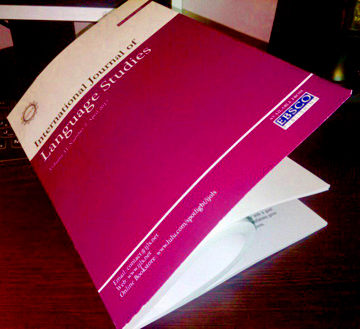
International Journal of Language Studies
A Quarterly Journal of Applied Linguistics
ISSN: 2157-4898 | eISSN: 2157-4901
Sherpa/RoMEO Color: Yellow
Editor: Mohammad A. Salmani Nodoushan
October 2026 - Volume 20 Number 4 - Pages 1-149
Asterisk (*) indicates corresponding author.
BACK TO TOP
From availability to presence: Emotional attachment to AI language tutors among Vietnamese EFL learners
, Ho Chi Minh City Open University, Vietnam | Contact Author
, Ho Chi Minh City University of Economics and Finance, Vietnam | Contact Author *
International Journal of Language Studies, 20(4), 1-24. | Download PDF | Add Print to Cart
AI language tutors have expanded learners’ access to support beyond conventional instructional settings. Although research has largely examined the pedagogical benefits of AI-assisted language learning, less is known about learners’ emotional relationships with these tools. This qualitative exploratory study investigated how Vietnamese EFL learners experienced emotional attachment to AI language tutors and the interactional experiences contributing to its development. Semi-structured interviews were conducted with 16 university students with extensive experience using AI for English learning, and the data were analyzed thematically. Findings showed that attachment was experienced less as affection toward AI itself than as a perception of AI as a meaningful presence characterized by perceived understanding and emotional reassurance. Attachment developed gradually through repeated interaction, fostering familiarity, psychological safety, and emotional dependability. Participants recognized AI as non-human, suggesting that attachment emerged from meaningful interactional experiences rather than anthropomorphic beliefs. The study offers a process-oriented account of learner-AI relationships in language education.
Citation: Bui, H. M., & Hoang, H. V. (2026). From availability to presence: Emotional attachment to AI language tutors among Vietnamese EFL learners. International Journal of Language Studies, 20(4), 1-24. https://doi.org/10.5281/zenodo.22972858
Keywords: AI-Assisted Language Learning; AI Language Tutors; EFL Learners; Emotional Attachment; Human-AI Relationships
BACK TO TOP
A comparative study of human and AI-assisted feedback on Saudi EFL students’ engagement and motivation in essay writing
, King Saud bin Abdulaziz University for Health Sciences, Saudi Arabia | Contact Author
, Taibah University, Saudi Arabia | Contact Author *
International Journal of Language Studies, 20(4), 25-46. | Download PDF | Add Print to Cart
This mixed-methods study examined how AI-assisted and human feedback influenced Saudi EFL students’ engagement and motivation in essay writing. Data were collected through surveys and semi-structured interviews. Quantitative findings showed similar overall engagement levels between students receiving AI feedback (M = 3.84) and those receiving human feedback (M = 3.83). Qualitative analysis revealed notable differences across engagement dimensions. AI feedback enhanced accessibility, provided immediate clarification, created opportunities for iterative revision, and offered emotional comfort during writing. In contrast, human feedback was valued for its personalization, contextual understanding, and social interaction. The findings also showed that students often adopted hybrid engagement practices by combining AI and human feedback to support their writing development. The study contributes empirical evidence to the growing literature on AI-assisted writing instruction and concludes by questioning the simplistic narratives about AI replacing humans. It provides a clear explanation of students’ engagement and motivation in AI-assisted writing instruction and offers practical advice for developing feedback in EFL writing classes.
Citation: Alkhateeb, A., & Dewali, T. W. (2026). A comparative study of human and AI-assisted feedback on Saudi EFL students’ engagement and motivation in essay writing. International Journal of Language Studies, 20(4), 25-46. https://doi.org/10.5281/zenodo.22973306
Keywords: Academic Writing Engagement; Academic Writing Motivation; AI-Assisted Feedback; EFL Writing; Human Feedback
BACK TO TOP
Assessing intercultural communicative competence in virtual environments: Vietnamese EFL teachers' perceptions of assessment criteria
, Ho Chi Minh City Open University, Vietnam | Contact Author *
, Ho Chi Minh City University of Education, Vietnam | Contact Author
, Ho Chi Minh City Open University, Vietnam | Contact Author
International Journal of Language Studies, 20(4), 47-72. | Download PDF | Add Print to Cart
This study examines Vietnamese tertiary EFL teachers’ perceptions of assessment-relevant abilities and behaviours for digital intercultural communication competence (DICC) in virtual environments. Drawing on a teacher-only subsample of 197 participants from universities across Vietnam, the study used a 30-item questionnaire covering five dimensions: Intercultural communication readiness, contextual sensitivity, virtual interactional competence, reflective adaptability, and operational performance. Descriptive statistics and Cronbach’s alpha were used to analyse perceived importance, response variation, and internal consistency. Findings showed stronger endorsement of respect, openness, contextual sensitivity, polite and clear language, communicative adjustment, and culturally appropriate disagreement, while confidence, participation, explicit reflection, sensitive-topic management, and broad collaboration were relatively less salient or more variable. The results suggest that teachers conceptualise assessable virtual ICC primarily as relational, context-sensitive, adaptive, and behaviorally observable competence. The study highlights the need for contextually grounded, multimethod assessment criteria in Vietnamese tertiary EFL education and offers directions for future assessment framework development.
Citation: Nguyen, T. M., Pham, H. N. H., & Bui, Q. T. T. (2026). Assessing intercultural communicative competence in virtual environments: Vietnamese EFL teachers' perceptions of assessment criteria. International Journal of Language Studies, 20(4), 47-72. https://doi.org/10.5281/zenodo.22974203
Keywords: DICC; Communication; Intercultural Communicative Competence; Language Education; Virtual Communication
BACK TO TOP
Framing AI in higher education: Discursive practices and legitimation strategies
, Far Eastern University, Philippines | Contact Author *
, Far Eastern University, Philippines | Contact Author
International Journal of Language Studies, 20(4), 73-92. | Download PDF | Add Print to Cart
This study analyzes the Gen AI policies of three Philippine private Higher Education Institutions (HEIs) in Metro Manila: Ateneo de Manila University (ADMU), De la Salle University (DLSU), and Far Eastern University (FEU). It uses a combination of Critical Discourse Analysis (CDA), Legitimation Strategies, and Framing Theory to examine how the technology is constructed and framed, and the power relations and governing structures built around it. The study found that Philippine HEIs discourses legitimize Gen AI integration through citing trusted authorities, emphasizing legal compliance, and moral appeals to religiosity/professionalism, among others. The framing constructs Gen AI tools as powerful but flawed tools that cannot be equal to or damage the capabilities of human students. Despite talking about Gen AI’s innovative capabilities and future roles, the policies are largely reactive and present-oriented, retaining traditional institutional authority and unequal power relations.
Citation: Author. (2026). Framing AI in higher education: Discursive practices and legitimation strategies. International Journal of Language Studies, 20(4), 73-92. https://doi.org/10.5281/zenodo.23131377
Keywords: Critical Discourse Analysis; CDA; Discursive Practices; Framing AI; Framing Theory; Higher Education; Legitimation Strategies
BACK TO TOP
Constructing smog crisis: An eco-critical discourse analysis of environmental worldviews in Pakistani English newspapers
, University of Management and Technology Lahore, Pakistan | Contact Author *
, University of Management and Technology Lahore, Pakistan | Contact Author
International Journal of Language Studies, 20(4), 93-120. | Download PDF | Add Print to Cart
This qualitative study examines how the smog crisis is discursively constructed in selected Pakistani English newspapers from 2016 to 2025, drawing on ecocentric and anthropocentric worldviews and selected postulates from Stibbe’s (2021) framework for eco-critical discourse analysis. The findings reveal a shift in the discursive representation of the smog crisis from a primarily anthropocentric perspective on urban problems to a more ecocentric one, in which smog is linked to climate change, environmental degradation, and systemic ecological failure. Erasure of agency, managerial framing, and human-centered evaluations remain dominant across print media narratives. The study contributes to the UN Sustainable Development Goals (11, 13, and 15) by highlighting gaps in messaging that may hinder policy action by sponsored institutions, policymakers, and media experts. The exclusion of national and local languages, as well as grassroots viewpoints, is a notable regional shortcoming and a limitation of this study that future research can address.
Citation: Author. (2026). Constructing smog crisis: An eco-critical discourse analysis of environmental worldviews in Pakistani English newspapers. International Journal of Language Studies, 20(4), 93-120. https://doi.org/10.5281/zenodo.23166642
Keywords: Anthropocentrism; Ecocentrism; Eco-Critical Discourse Analysis; Pakistani English Newspapers; Smog Crisis; UN Sustainable Development Goals
BACK TO TOP
From communication apprehension to test anxiety: The mediating role of fear of negative evaluation in multilingual ESL classrooms
, Birla Institute of Management Technology (BIMTECH), India | Contact Author *
, Sri Balaji University Pune, India | Contact Author
, JK Lakshmipat University | Contact Author
International Journal of Language Studies, 20(4), 121-149. | Download PDF | Add Print to Cart
The present study investigates the structural dynamics of English-speaking anxiety among secondary school learners by validating and modelling the three-factor structure of the Foreign Language Classroom Anxiety Scale (FLCAS), adapted as the English Language Classroom Anxiety Scale (ELCAS). Data were collected from students in Grades 9-12 across selected schools in India. Independent samples t-tests and ANOVA were used to examine demographic variations in anxiety levels. Confirmatory factor analysis and structural equation modelling were employed to test the construct validity of the scale and analyse the relationships among communication apprehension, fear of negative evaluation, and test anxiety. A mediation model was also estimated to examine the mechanisms linking communication-related anxiety to performance-related anxiety. The findings confirm the three-factor structure of classroom anxiety and reveal significant demographic differences. Fear of negative evaluation mediates the relationship between communication apprehension and test anxiety. The study contributes to theoretical discussions on language anxiety and offers pedagogical insights for fostering supportive communication environments in multilingual ESL classrooms.
Citation: Vyas, P., Bhatia, M., & Singh, U. (2026). From communication apprehension to test anxiety: The mediating role of fear of negative evaluation in multilingual ESL classrooms. International Journal of Language Studies, 20(4), 121-149. https://doi.org/10.5281/zenodo.23178870
Keywords: Classroom Interaction; Communication Apprehension; ESL Education; Evaluation Anxiety; Language Anxiety; Multilingual Learning Environments; Structural Equation Modelling
BACK TO TOP
Copyright © International Journal of Language Studies 2007 - All Rights Reserved
Template by OS Templates